
AI Case Management Software for Bankruptcy Firms (June 2026)

Everyone running a bankruptcy practice above 50 cases monthly knows the bottleneck by now. It's not the law. It's the eight-hour petition cycle, the manual PACER checks, and the spreadsheet your paralegal updates by hand because the case system doesn't talk to the billing tool. Legal AI adoption doubled in 2026, and high-volume firms are switching to AI bankruptcy case management software that owns workflows natively instead of requiring someone to maintain the glue between five tools. We reviewed which platforms in 2025 and 2026 actually close that gap for Chapter 7 and Chapter 13 practices processing serious volume.
TLDR:
- AI case management adoption hit 69% in 2026, and purpose-built bankruptcy tools now own petition assembly, means test math, and court filing natively.
- Petition prep drops from an 8-hour cycle to reviewable packets when AI agents parse credit reports and propagate one value across 21+ linked fields.
- Court filing runs asynchronously in 7 to 10 minutes with pre-filing validation that stops rejections before they happen.
- Generalist legal software leaves you maintaining integrations; bankruptcy-specific systems own the lifecycle without external worksheets or manual PACER.
- Glade compresses petition assembly to roughly 2 hours and files Chapter 7 and Chapter 13 cases across 14 PACER-automated districts with deterministic means test calculation.
Why Bankruptcy Law Firms Are Adopting AI Case Management in 2026
The gap between firms running AI agents on petition packets and firms still keying credit reports by hand widened fast in the last twelve months. Legal AI adoption hit 69% in 2026, more than double the 31% recorded in 2025, and 92% of legal professionals now touch at least one AI tool during a normal workday. Experimentation is over. Firms are buying infrastructure.
Bankruptcy got there late on purpose. The practice is form-heavy and calculation-intensive, which is the work AI should own, but the market is smaller than litigation or corporate, so vendors chased bigger checks first. That flipped in 2026. Purpose-built bankruptcy tooling exists now, and high-volume practices are adopting it because spreadsheets and Best Case stacks cannot absorb 100-case months without staff burning out.
What AI Case Management Actually Does in a Bankruptcy Practice
AI case management for bankruptcy is a set of workflows the software either owns natively or doesn't:
- Petition assembly: AI agents parse paystubs, credit reports, and IDs, then populate the right schedules with the right math. Generic tools stop at field mapping.
- Document intelligence: Multi-account extraction from bank and investment statements, VIN reads off photographed titles, automatic orientation correction. Built for the mess clients actually upload.
- Means test calculation: Deterministic, rule-based math against state medians and statutory thresholds, not LLM inference. Court-defensible by design.
- Court filing orchestration: Native PACER submission, district-specific form selection, signature and date generation at filing time.
A generalist case system can hold a bankruptcy matter. It cannot run one. Best bankruptcy case management software owns the complete workflow natively.
How AI Handles Petition Preparation and Schedules
Petition prep is where AI earns its keep. The 8-hour assembly cycle most firms still run is mostly transcription and arithmetic, and that work compresses once specialized AI tools for petition preparation own it.

Here's the sequence a purpose-built system actually runs:
- Ingestion: paystubs, tri-merge credit reports, IDs, titles, and bank statements get parsed by specialized agents. Income agents handle gross, taxes, retirement, and withholdings with pay-period-accurate math. Credit report agents extract creditors, prior bankruptcies, foreclosures, and real estate records.
- Schedule population: one value entered once propagates across 21+ linked fields. Schedule D pulls from the credit report, A/B from property records, I from the income organizer.
- Means test: deterministic math syncs to Form 122 in real time, so eligibility surfaces before assembly starts.
- Exemptions: a jurisdiction-specific agent calculates homestead from real estate value minus secured liabilities, shows statute reasoning, and accepts attorney override.
- Validation: documents get checked against district rules and flagged Approved, Needs Review, In Review, or Failed.
The packet that comes out is reviewable, not draftable from scratch.
Document Collection and Client Communication Automation
Paralegals lose hours every week to "did you upload that yet?" messages. Past 50+ concurrent cases, that follow-up burden becomes cognitive overload, not a time-management problem.
Event-driven workflows flip the chase. The system dispatches document requests, reminders, and status nudges automatically when case events fire (questionnaire completed, payment received, missing item detected), so clients chase themselves through a portal showing exactly what's outstanding. Automate your client intake and document collection to eliminate paralegal follow-up burden.
A few mechanics that matter for high-volume practice:
- Joint filer deduplication: shared records (deeds, tax returns, W-2s) are requested once and applied to both debtors. Separate uploads only for per-debtor artifacts like credit counseling certificates and IDs.
- Time-zone-aware SMS: outbound texts restricted to 8 AM-9 PM local for TCPA compliance, on by default.
- Appointment-aware de-confliction: task pings go silent when a client has an upcoming consult.
- Tone configuration: AI follow-up voice is set once at the firm level (informal vs. formal, firm-specific phrasing) and propagates across every automated touchpoint.
The paralegal job stops being inbox triage and becomes review of completed files.
Court Filing Automation and PACER Integration
Filing day used to mean a paralegal sitting at PACER for an hour clicking interstitial pages, attaching PDFs in the right order, and praying nothing got rejected.
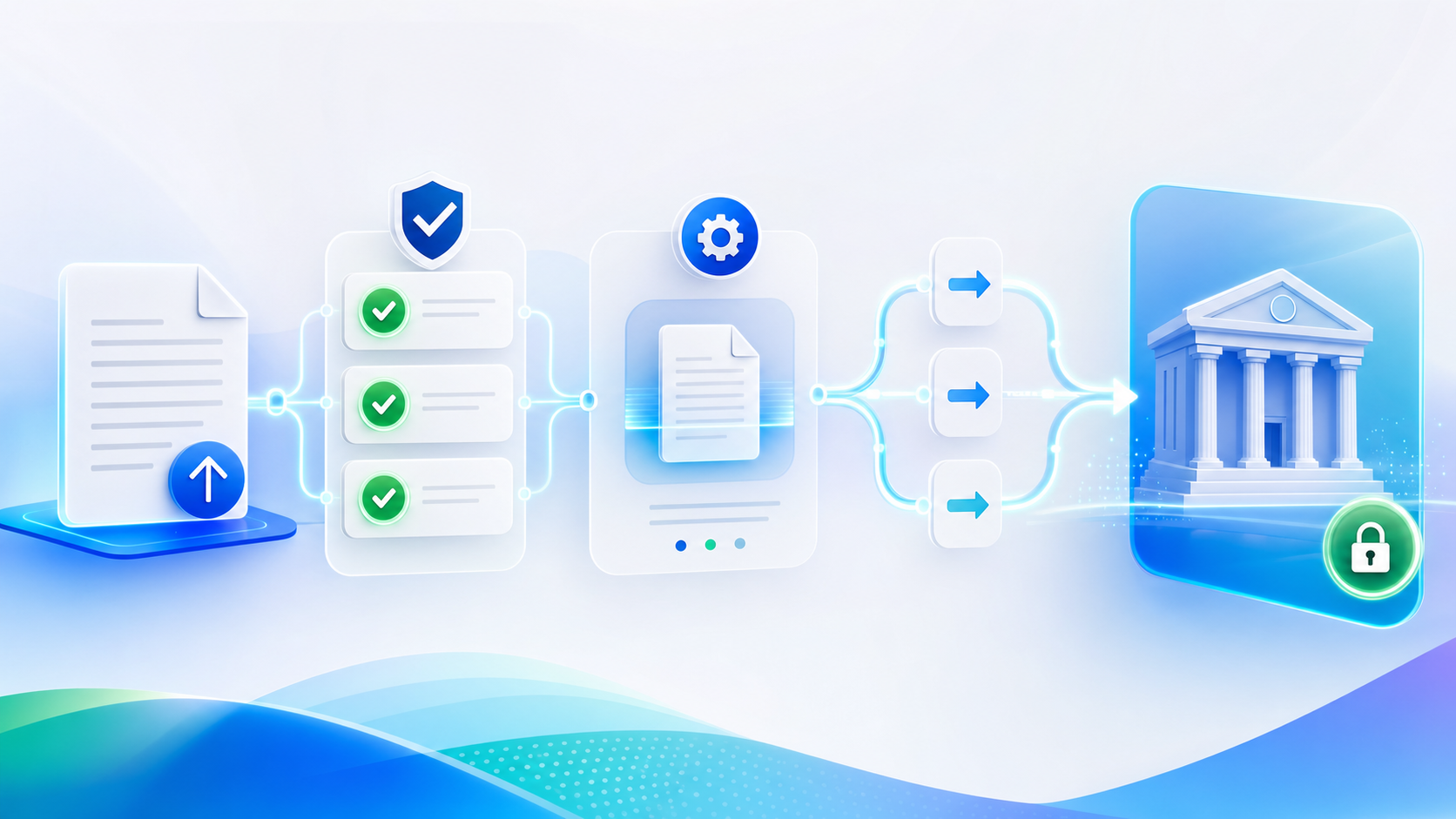
Submission runs asynchronously, typically completing in 7 to 10 minutes once initiated. See how to e-file on PACER for the complete filing workflow. The system handles district-specific warnings, confirmation dialogs, and event sequencing without the attorney at the keyboard. Date and signature generation happens at filing time, killing the most common refile cause: signature dates that don't match the filing date. Read our complete PACER filing automation guide for technical details.
Two things matter more than speed for high-volume practices:
- Rejection prevention: pre-filing AI validation checks every document against district rules and surfaces gaps as a remediation checklist. Florida Southern Chapter 7 cases get persistent deficiency warnings for missing attachments. Court rejections become pre-filing fixes.
- Notice ingestion: firms add a dedicated
@pacer.glade.aiemail to their PACER account and incoming notices flow into the right matter automatically. AI classifies each notice by function (341 Meeting, Motion to Dismiss, Deficiency Notice, Order Discharging Debtor) across all 94 federal districts without per-district keyword maintenance. Automate your court notice tracking to eliminate manual docket checks.
Each notice PDF is ingested once and accessible to the whole team, so per-page PACER fees stop multiplying. Hearing dates, Zoom credentials, trustee contact info, and timezone-normalized calendar entries extract automatically. Notice-triggered workflows fire client texts, paralegal tasks, and status changes the moment a notice lands. Manual docket checks become exception handling instead of a daily routine.
Payment Plan Management and Trust Accounting
Bankruptcy clients can't pay upfront in full. That reality shapes the AR machinery a high-volume practice needs.
- Bifurcated retainers: pre-filing and post-petition fees split natively, with zero-down structures viable for firms processing 30 to 60 bifurcation cases monthly.
- Automated installment collection: stored payment methods charged on configured cadence until the invoice balance clears. Failed payments retry up to 3 times before the firm gets notified.
- Trust accounting routing: line-item destination accounts (IOLTA vs. operating) prevent commingling at the invoice level.
- Payment gates: workflow progression blocks until milestone thresholds clear, stackable across stages (retainer signed, credit report pulled, filing prep).
Bolted-on billing integrations cannot enforce gates inside the case workflow. With native payments, the payment state and the case state are the same record.
Choosing Between General Legal Software and Bankruptcy-Specific AI
The question to ask a vendor isn't "do you support bankruptcy?" It's "what percentage of a Chapter 7 or 13 case does your system own without a second tool?"
Coverage Dimension | General Legal Software | Bankruptcy-Specific AI |
|---|---|---|
Petition assembly | Field mapping, manual schedule entry | Agentic parsing, 21+ field propagation |
Credit report ingestion | None or PDF attachment | One-click Schedule D, prior filings, property records |
Means test | External worksheet | Deterministic engine synced to Form 122 |
Court filing | Manual PACER export | Native ECF submission across supported districts |
District rules | Manually configured | Out-of-box trustee fees, no-look caps, local forms |
A generalist case system with 300+ integrations still leaves you maintaining the glue between them. Best bankruptcy software for attorneys scores vendors on lifecycle coverage, not integration count. Score vendors on lifecycle coverage, not integration count.
Implementation Timeline and Firm Readiness
Individual attorneys testing ChatGPT is not the same as a firm running AI in production. The gap between the two is implementation, and most firms underestimate how much that gap matters until they're three months into a Filevine configuration project.
Setup completes in days, not weeks or months. A few realities that shape a clean cutover:
- Parallel operation: legacy tools (Best Case, Jubilee, Google Sheets trackers) run alongside the new system during cutover. Documented migration paths handle email and name-based deduplication, so no case gets dropped.
- Staff training: paralegals own the daily interface, so train them first. Attorney review workflows layer on top.
- Onboarding self-advances through lifecycle states once the kickoff call books, with admin visibility into stuck graduations.
Firms above 150 cases monthly hard-cutover. Sub-50-case practices can run parallel for a few weeks without meaningful drag.
How Glade AI Automates the Complete Bankruptcy Case Lifecycle
Glade is purpose-built for consumer bankruptcy, which is why the lifecycle stops looking like five disconnected tools and starts looking like one record.
- Case Intelligence assembles the file before a paralegal opens it: credit reports, paystubs, property records, and prior filings merge into a pre-populated questionnaire.
- AI document review runs before paralegal review, so paralegals validate completed packets instead of building them. The 8-hour petition compresses substantially once AI owns the parsing, transcription, and arithmetic.
- One-click federal court filing executes in 7 to 10 minutes asynchronously across 14 PACER-automated districts, with Chapter 7 and Chapter 13 both first-class. The Chapter 13 Plan Calculator ships production-ready across all 90 federal bankruptcy districts.
- Court notices route into the right matter automatically, classified by function across 94 districts.
- Native payments handle bifurcated retainers, zero-down structures, and IOLTA routing without a separate billing tool.
The stack Glade replaces is usually Best Case + Clio + Court Drive, held together by a paralegal who knows where every API key lives. We own the lifecycle natively so that connective tissue stops being a job.
Final Thoughts on How Bankruptcy Practices Are Using AI Case Management
Experimentation is over. Firms are buying infrastructure, and the ones that got there first are shipping 100-case months without burning through paralegals because the software owns the transcription and arithmetic it should. The petition that used to take 8 hours compresses to roughly 2 once specialized agents handle paystub parsing, credit report extraction, and deterministic means test math. Book a demo from document collection through federal court filing. Your paralegals validate completed packets instead of building them from scratch, and the stack of disconnected tools stops being a job someone on staff has to hold together.
FAQs
Can I build a bankruptcy petition without AI and still hit the same throughput?
No. Manual petition prep for a Chapter 7 case averages 8 hours of paralegal time; credit report transcription alone runs 60+ minutes when you're keying line-by-line into Schedules D, E, and F. AI agents compress that cycle to roughly 2 hours by parsing paystubs, pulling creditor lists from tri-merge reports, and populating 21+ linked fields automatically. At 100+ cases monthly, the math stops working without automated document intelligence.
AI case management vs. generic practice software for bankruptcy firms?
Generic practice software treats bankruptcy as one workflow among dozens: you get field mapping and document storage, but no credit report ingestion, no deterministic means test engine, no district-specific trustee fee tables. AI case management built for bankruptcy owns petition assembly with specialized agents: paystub parsing that handles pay-period-accurate income calculations, exemptions calculators that apply jurisdiction-specific statutes, and pre-filing validation against 94 federal district rules. The architecture difference is lifecycle coverage. Purpose-built tools own intake through post-filing in one system instead of forcing you to maintain five disconnected tools and a spreadsheet tracker.
How does automated PACER filing actually prevent petition rejections?
Two mechanisms: pre-filing validation and signature-date synchronization. AI document review checks every filing against district-specific rules before the court sees it. Florida Southern Chapter 7 cases get persistent deficiency warnings for missing mandatory attachments, catching gaps that would trigger rejection notices days later. Automated signature and date generation runs at filing time, eliminating the most common refile cause: petitions prepared one day and filed the next get rejected because the signature date doesn't match the filing date. Courts in the 14 supported districts receive packets validated before submission instead of finding errors after acceptance.
What happens when a paralegal is managing 20,000+ active tasks across concurrent cases?
Once a paralegal is carrying 20,000+ active tasks across concurrent cases, the problem stops being time management and becomes cognitive overload. Manual follow-up communication consumes hours every week. "Did you upload that yet?" messages multiply across dozens of open document requests, and cases go dormant for months without intervention because no system enforces forward motion. Event-driven workflows flip the chase: document requests, reminders, and status nudges fire automatically when case events trigger them, so clients chase themselves through a portal showing exactly what's outstanding and paralegals stop writing individual follow-up emails entirely.
How long does migration from Best Case or Jubilee actually take for a 100-case-per-month firm?
Setup completes in days, not weeks or months. Documented migration paths exist for Best Case, Jubilee, and Google Sheets trackers with email and name-based deduplication; firms run legacy tools alongside the new system during cutover so no case gets dropped. Firms above 150 cases monthly hard-cutover because the overhead of maintaining two live systems compounds too fast; sub-50-case practices can run parallel for a few weeks without meaningful drag. The bottleneck is staff training, not data transfer. Paralegals own the daily interface and need to learn case-progression workflows before attorneys layer review steps on top.