
Write a Court Motion Template the Right Way – July 2026

Most lawyers searching for a motion template find generic examples that skip the jurisdiction-specific rules and procedural requirements that actually determine whether the clerk accepts your filing.
TLDR:
- Court motions require six mandatory components: caption with case number, specific title, notice with hearing date, relief statement, legal argument tied to statutes, and signature block with bar number.
- Federal courts require 16 days advance notice, 1-inch margins, 14-point font, and 5,200-word caps, but state and local rules add stricter requirements that vary by jurisdiction.
- File at least 37 days before your hearing date to account for service time and opposition deadlines, or risk rejection for procedural errors like missing case numbers or wrong motion types.
- For bankruptcy firms, Glade extracts case data from your files, auto-populates petition components with jurisdiction-specific formatting, and tracks filing deadlines across active Chapter 7 and Chapter 13 cases to reduce paralegal hours on administrative work.
What Is a Motion for Court and When You Need One
A court motion is a formal written request asking a judge to make a ruling or take action in your case. It's a structured ask: you tell the court what you want and why the law supports it. Judges don't act on their own - someone has to ask.
People file motions for many reasons, including pushing a hearing date, dismissing a weak claim early, suppressing improperly obtained evidence, or requesting a temporary custody order in a family case. In criminal cases, motions often target search-and-seizure issues or sentencing considerations.
This guide covers motion types, building a template, formatting for your jurisdiction, and filing correctly.
Understanding Different Types of Court Motions
Before drafting a motion, it helps to know which type you actually need. The category determines the format, the standard the court applies, and often whether a hearing is required.
Criminal Court Motion Types and When to File Each
In criminal cases, motions fall into a few recurring categories, each tied to a specific procedural objective:
- Motion to suppress evidence: filed before trial under the Fourth Amendment when law enforcement obtained evidence through an unlawful search or seizure. The court holds an evidentiary hearing where the prosecution must show the search was lawful. If granted, the suppressed evidence cannot be used at trial, often forcing a plea or dismissal.
- Motion to dismiss charges: filed when the charging document is legally defective, the statute of limitations has run, or the prosecution lacks sufficient evidence to proceed. The standard varies by jurisdiction, but courts generally assess whether the facts alleged, taken as true, support the charge.
- Motion for a continuance: filed to reschedule a hearing or trial date. Courts weigh the reason for the request against prejudice to the opposing party. Last-minute continuances without good cause are routinely denied.
- Motion for discovery: filed to compel the prosecution to produce evidence it is required to disclose under Brady v. Maryland or applicable criminal procedure rules. Must identify the specific materials requested and the rule requiring their production.
Civil Court Motion Types and When to File Each
Civil litigants file several recurring motion types, each tied to a specific procedural moment:
- Motion for summary judgment: filed after discovery closes, arguing no genuine dispute of material fact exists and the moving party is entitled to judgment as a matter of law under Rule 56. Requires a separate statement of undisputed facts in most jurisdictions.
- Motion to compel discovery: filed when the opposing party fails to respond to interrogatories, document requests, or deposition notices. Must include a certification that you attempted to resolve the dispute informally before filing.
- Motion in limine: filed before trial to exclude specific evidence (expert testimony, prior bad acts, hearsay) before it reaches the jury. Courts rule on these at the pretrial conference or just before opening statements.
- Motion to dismiss: filed early in the case under Rule 12(b) to challenge defects in the complaint itself, such as lack of jurisdiction, improper venue, or failure to state a claim. The legal standard varies by subsection, so citing the wrong one gives opposing counsel an easy rebuttal.
Family Court Motion Types and Filing Requirements
Family court motions cover custody modifications, support adjustments, and emergency protective orders. Each requires different documentation, filing thresholds, and hearing timelines that vary by jurisdiction.
- Motion to modify custody: filed when circumstances have changed materially since the original custody order (e.g., a parent relocating, a child's school needs shifting, or a change in a parent's work schedule). Courts apply a two-step test: first, whether a substantial change in circumstances has occurred; second, whether modification serves the child's best interests. Without clearing the first step, the court will not reach the merits.
- Motion to modify child support: filed when income, custody time, or the child's financial needs have changed enough to warrant recalculation. Most jurisdictions require a threshold percentage change in the support amount (typically 10 to 15 percent) before approving a modification. Attach updated income documentation and a completed support calculation worksheet at filing.
- Motion for emergency protective order: filed when a parent or child faces immediate risk of harm. Courts can issue a temporary order on the same day without the other party present (called an ex parte order) based solely on the moving party's sworn statement. A full hearing with both parties follows within days, where the moving party must substantiate the emergency claim with evidence.
- Motion to enforce a court order: filed when one party is not complying with an existing custody or support order. The moving party must document specific violations with dates and details. Courts can respond with contempt findings, wage garnishment, or modifications to the underlying order depending on the severity and pattern of non-compliance.
Required Components Every Motion Template Must Include
Every motion has the same required skeleton. Miss any piece and the clerk may reject it before a judge reads a word.
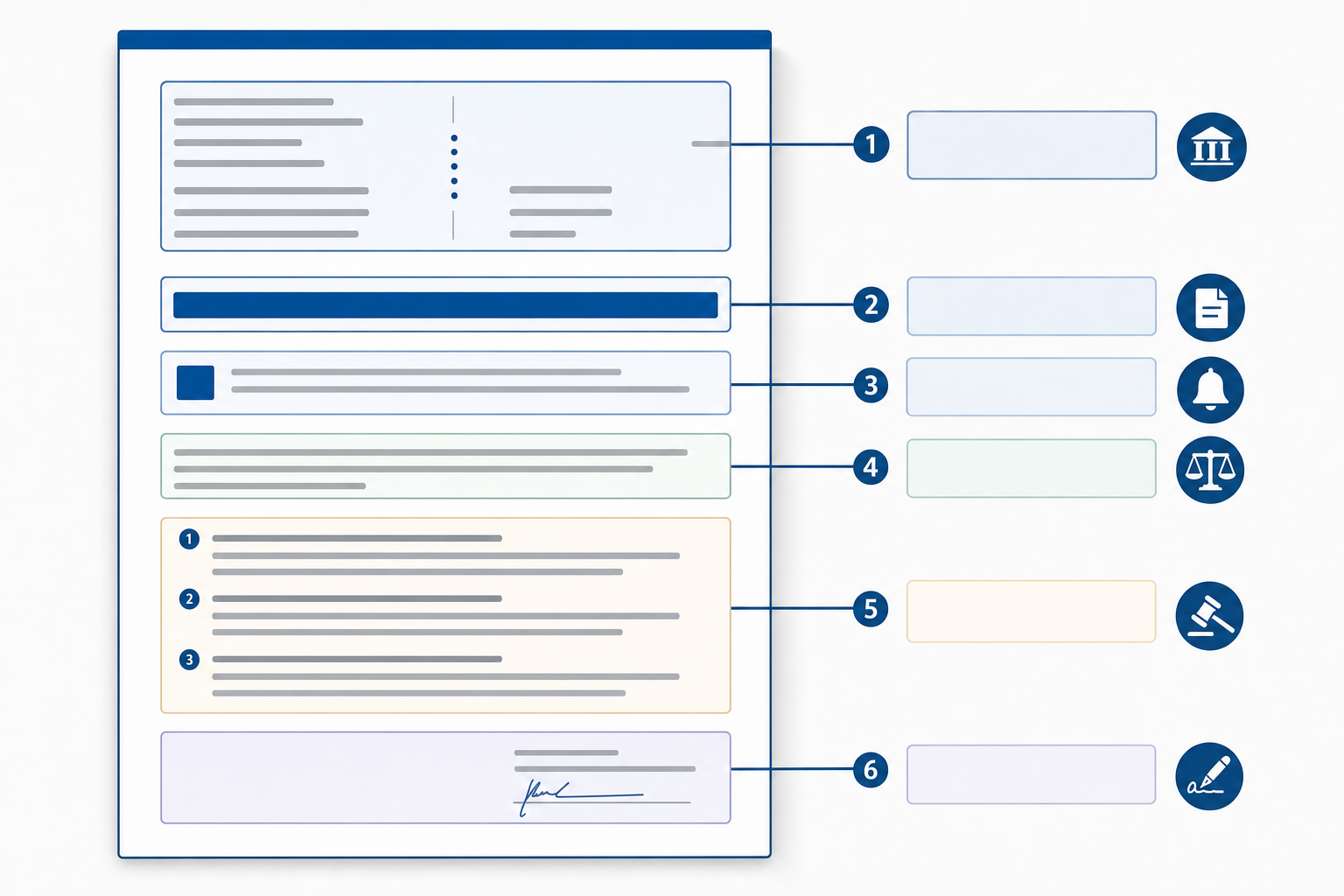
Here are the components every motion template needs:
- Caption: Court name, case number, and all party names at the top, telling the clerk exactly where to route it.
- Title: Specific and descriptive ("Defendant's Motion to Suppress Evidence"), not generic.
- Notice of Motion: Hearing date, time, and courtroom, required so opposing counsel can respond.
- Statement of Relief: One or two sentences stating exactly what you are asking the court to do.
- Legal Argument: The body of the motion, organized by numbered points tied to applicable statutes or case law.
- Signature Block: Attorney name, bar number, contact information, and date, which many courts require for filing acceptance.
How to Write the Motion Body Using Persuasive Legal Structure
The body of a motion follows a four-part sequence, and each part has one job. They build on each other, so skipping or collapsing sections weakens the whole argument.

Section | Purpose | Template Starter |
|---|---|---|
Introduction | State the relief and procedural posture | "Movant [Party Name] respectfully requests that this Court..." |
Statement of Facts | Chronological, objective account | "On [Date], [Party] [specific action]..." |
Legal Argument | Connect facts to applicable law | "Under [Statute/Rule], courts have held that..." |
Conclusion | Request specific court action | "For the foregoing reasons, [Party] respectfully requests..." |
Keep facts neutral and in sequence. Courts want clarity in the facts section, not advocacy. Save your persuasion for the argument section, where each numbered point should open with the legal standard and then map your specific facts to it. One principle per heading keeps the structure clean and judges on track.
Formatting Requirements and Court-Specific Rules
Federal courts set the baseline under the Federal Rules of Civil Procedure. Computer-produced motions cap at 5,200 words; handwritten or typewritten submissions are limited to 20 pages. Most courts also require:
- Font: 14-point for body text, with 12-point acceptable for footnotes
- Margins: 1-inch on all sides
- Line spacing: Double-spaced throughout the body
- Page numbers: Consecutive, typically centered at the bottom
- Caption: Court name, case number, all parties, and motion title on page one
State and local rules frequently add stricter requirements on top of these. California courts follow specific California Rules of Court formatting standards that differ from federal defaults. Before filing anywhere, check your court's local rules page directly. Many district courts publish standing orders that override general rules, and a clerk will reject a motion for something as small as the wrong font size.
Filing Deadlines and Timeline Management for Court Motions
Motion deadlines in federal court follow a predictable rhythm. General motions require 16 days advance notice under FRCP 6(c)(1) before the hearing date, plus service time. Opposing parties have 14 days to respond, and reply briefs typically run 5 to 7 days after that.
Work backward from your hearing date to stay on track with matter management software:
- File and serve at least 37 days out to give yourself enough buffer for service time and any processing delays.
- Opposition is due around 21 days out, so factor that into your preparation timeline.
- Reply briefs are typically due around 14 days before the hearing.
How to Handle Emergency Motions and Compressed Timelines
Emergency motions compress the entire timeline to 24 to 48 hours notice. To get a court to act that quickly, you need to show irreparable harm, meaning the injury cannot be remedied after the fact by waiting for a regular hearing. In federal court, file an ex parte motion supported by a sworn declaration describing the emergency, then request an expedited briefing schedule or ask the court to waive the opposition period. State courts vary: some require telephonic notice to the opposing party before the judge will consider an ex parte application; others allow a pure ex parte filing when prior notice would defeat the purpose. In both venues, your declaration carries most of the weight, so be specific about dates, actions, and why delay causes irreversible harm. Summary judgment oppositions get 28 days in most federal courts.
State courts vary widely, so always confirm with local rules before setting any internal deadline. In California, most courts follow California mandatory e-filing rules, with self-represented litigants encouraged but not required to use e-filing systems.
If a deadline won't work, file for a continuance early. Judges are generally understanding about scheduling conflicts, but far less forgiving when you miss the deadline and ask for relief after the fact.
Supporting Documents and Evidence Attachments
Most motions require supporting documents filed alongside the motion itself:
- Memorandum of law: the brief that lays out your legal argument in full
- Declarations or affidavits: sworn statements from parties or witnesses, authenticated by signature
- Exhibits: labeled A, B, C or numerically, in the order they first appear in the motion body
- Proposed order: a draft ruling pre-written for the judge to sign if they grant your motion
- Certificate of service: confirmation that opposing counsel received the filing
Reference each exhibit directly in the motion text by its label, writing "See Exhibit A" or "Attached hereto as Exhibit 1" so the judge can follow your argument without searching through attachments. Document management systems automate exhibit labeling and organization. Local rules often specify numbering conventions, so confirm before filing.
Common Mistakes That Get Motions Rejected or Denied
Federal courts report that roughly 20 percent of civil filings involve pro se parties (per USCOURTS annual data), and procedural errors are the leading reason those filings stall. Attorney-filed motions hit the same traps.
The most common errors that cause rejection or denial:
- Caption missing the case number, court division, or a party name
- Notice of motion omits the hearing date, time, or courtroom
- No proof of service attached at filing
- Motion exceeds page or word limits without prior court approval
- Legal argument section cites no statute, rule, or case law
- Wrong motion type filed for the relief actually sought (filing a motion to dismiss when summary judgment is the right vehicle, for example)
Clerks catch the first four before the motion reaches a judge. The last two get denied after judicial review. Neither is recoverable without refiling.
Motion Templates for Specific Case Types
Generic templates get you started, but each case type has unique requirements that affect what you include and how you structure your argument.
Family Court Motion Requirements
Custody modification motions require a "change in circumstances" showing before the court considers the substance of your request. Always attach a proposed parenting plan or updated support calculation worksheet as an exhibit, since many judges expect one at filing and will not schedule a hearing without it. Legal document automation can generate these attachments from your case data.
Criminal Court Motion Requirements
Suppression motions need a detailed factual chronology of the search or seizure, beyond a legal argument alone. Discovery motions should itemize exactly what materials you are requesting and cite the specific criminal procedure rule that requires disclosure.
Civil Litigation Motion Requirements
Summary judgment motions require a separate statement of undisputed facts, numbered line by line, in most jurisdictions. For Rule 12(b)(6) dismissal motions, attach no exhibits: the court considers only what the complaint alleges on its face, and attaching evidence can convert the motion to one for summary judgment, triggering a different legal standard and a longer briefing schedule.
How Glade AI Simplifies Motion Preparation for Law Firms
For bankruptcy firms processing dozens of Chapter 7 and Chapter 13 filings each month, the administrative side of preparation adds up fast. Glade extracts case data directly from your files and auto-populates all six mandatory motion components: caption, title, notice of motion, statement of relief, legal argument, and signature block, so paralegals aren't rebuilding structure from scratch on every filing. Learn more about law automation benefits and use cases across different practice areas.
Jurisdiction-specific formatting, fonts, margins, page limits, caption requirements, is applied automatically, so what comes out of the template already meets local rules before anyone reviews it. Glade also tracks filing, opposition, and reply deadlines across all active cases simultaneously, so nothing slips when your team is managing high volume.
Your legal team spends time on the argument, not the template.
Our AI agents track filing deadlines across multiple active cases simultaneously, so nothing slips when your team is managing high volume. Motion prep connects directly to case management, client communications, and native payments in one unified system, keeping everything in sync without bouncing between disconnected tools.
Your legal team spends time on the argument, not the template.
Final Thoughts on Filing Court Motions
Writing motions well takes practice, but the procedural requirements don't change much between cases. Once you have your legal motion template built correctly for your jurisdiction, it's mostly about adapting the argument and keeping deadlines straight across your active caseload. Formatting stays consistent, so the real work is in the facts and legal analysis, not rebuilding the structure every time. If you want to see how Glade automates the setup work and keeps your filing calendar on track, book a demo and we'll walk through it.
FAQ
Can I file a motion with the court without an attorney?
Yes. You can file a motion pro se (representing yourself), but you must follow the same formatting rules, deadlines, and procedural requirements as attorneys. Courts provide free court motion templates in many jurisdictions, and clerks can answer procedural questions but cannot give legal advice on what motion to file or how to argue your case.
Legal motion template Word vs PDF - which format should I use?
Use Word for drafting and internal edits, then convert to PDF before filing. Most courts require PDF submissions through their electronic filing systems, and PDFs preserve your formatting across different computers. Keep the Word version as your working file so you can adapt the template for future motions without starting from scratch.
How long does it take to file a motion in court after I submit it?
Filing happens immediately once the clerk accepts your submission, but getting a hearing date typically takes 30-60 days, depending on the court backlog. In federal court, you must provide at least 16 days notice before your hearing, plus time for service and opposition briefs - so work backward from your desired hearing date and file at least 37 days out to stay on schedule.
What happens after a motion is filed in family court?
The opposing party receives your motion through service and has 14-30 days to file a written opposition (deadlines vary by jurisdiction). The court reviews both submissions, schedules a hearing if required, and issues a ruling either at the hearing or in a written order afterward. Emergency motions in family court can get same-day or next-day hearings for issues like protective orders or custody emergencies.
How do I write a motion template that works across multiple case types?
Start with the six required components: caption, title, notice of motion, statement of relief, legal argument, and signature block. Then customize the argument section based on your case type. Criminal motions need detailed chronologies of events, family court motions require change-in-circumstances showings, and civil motions often need separate statements of undisputed facts, so your template's argument structure should flex while the formatting stays consistent.
See What Glade Can Do for You
Find out how Glade can build you customized
AI Agents to supercharge your operations