
AI for Bankruptcy Petition Prep (June 2026)

The difference between legacy bankruptcy petition software and AI tools comes down to what happens when a credit report hits your intake folder. One asks a paralegal to open it, read every tradeline, and key the data into Schedules D, E, and F by hand. The other reads the report, classifies each debt, and populates every field automatically. That distinction is the reason some firms finish petitions in two hours while others are still keying at 8 p.m.
TLDR:
- AI agents read paystubs and credit reports directly, populating Schedules D, E, and F without manual keying.
- Means test math must run on deterministic logic, not LLM inference, to produce court-defensible numbers.
- AI parses messy documents; rule-based engines handle statutory calculations like the means test.
- Demand source attribution on every auto-populated field before signing any AI petition tool.
- Glade collapses 8+ hours of petition prep to under 2 with document agents that parse 33 paystubs in under a minute.
How AI Agents Auto-Populate Bankruptcy Petitions From Uploaded Documents
Traditional petition software gives you fields. AI agents give you a filled petition.
The distinction changes what your paralegal does at 6 p.m. with a stack of client PDFs. Legacy tools like Best Case ask someone to key credit report data into Schedule D, transcribe paystubs into the Income Organizer, and re-enter the debtor name across 21 fields. AI bankruptcy filing software reads documents directly and populates the schedules. AI agents read documents directly and populate the schedules.
What AI petition preparation software does that a form does not:
- Reads uploaded paystubs, credit reports, and bank statements without keyed entry
- Extracts creditor names, account numbers, balances, prior bankruptcies, and real property from a tri-merge report
- Populates Schedule A/B, Schedule D, and the creditor matrix from extracted data
- Runs the means test against current median income tables
- Carries a single entered value across every downstream schedule
The agent does not decide whether to file or which exemptions to elect. It handles keying, cross-referencing, and math. The attorney reviews, overrides, and signs.
How AI Document Intelligence Extracts Petition Data From Paystubs, Credit Reports, and Bank Statements
Document intelligence is the engine underneath petition automation. Without it, you are back to keying.

What the layer does with client uploads:
- Paystubs: pulls gross, taxes, retirement, withholdings, and YTD as discrete line items, then applies frequency multipliers to hit monthly figures for IRS means-test math
- Tri-merge credit reports: parses creditors, account numbers, balances, and types into Schedules D, E, and F; surfaces prior filings and real property tied to SSN
- Bank and investment statements: captures every account in a single document instead of dropping entries past the first
- Vehicle titles: dual-layer OCR plus image analysis pulls VINs, plates, and low-contrast text; auto-corrects orientation on phone photos
Classification runs before extraction, routing each file to the correct parser and schedule mapping. The extraction layer handles both structured and unstructured document types, see our full breakdown of AI in bankruptcy law for more context.
Means Test Automation: Deterministic Calculation vs. AI Estimation
The means test is where AI overreach becomes malpractice exposure. Form 122A-1 and 122A-2 are statutory math: a six-month income lookback, frequency multipliers, IRS expense standards, and a comparison against state median tables the U.S. Trustee updates annually. AI tools for bankruptcy petition preparation must handle this calculation deterministically.
Run that math through an LLM and you get a number you cannot defend to a trustee. Run it through a deterministic engine and the output is reproducible, auditable, and traceable to the exact rule that fired.
The right split, documented in means test workflows, looks like this:
- AI finance agents parse the messy front end: gross, withholdings, and YTD from inconsistent paystub formats
- Rule-based logic owns the back end: frequency conversion, deduction eligibility, median comparison, Form 122 population
Ask any tool which layer owns the calculation. If the answer is "the model," walk away.
Schedule Population: From Credit Report to Court-Ready Petition Forms
Pulling a tri-merge takes 30 seconds. manual schedule entry takes an hour, and that hour is where high-volume practices bleed paralegal time.
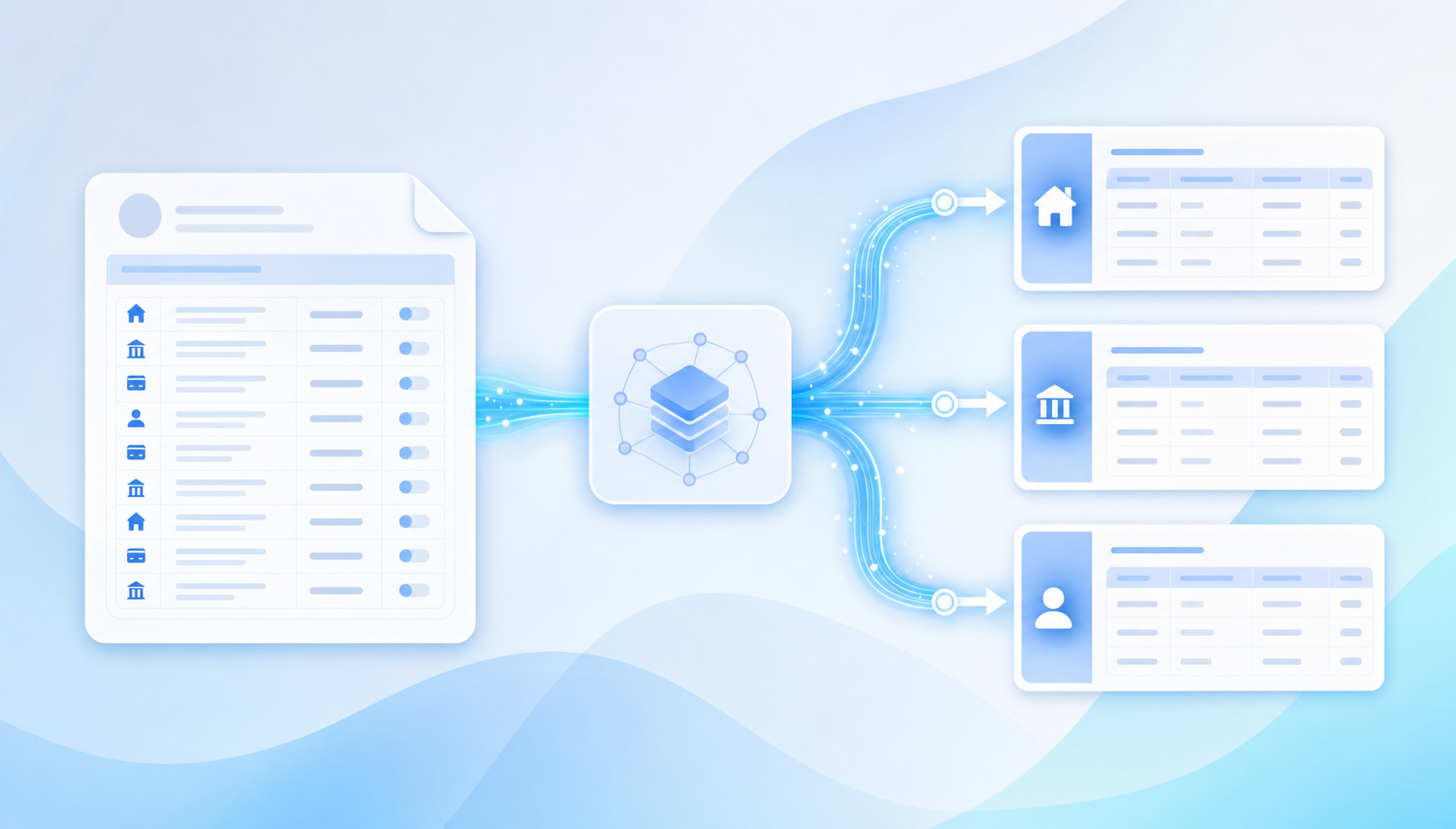
AI agents close the gap. Once a credit report lands in the case, extraction parses every tradeline into a structured record: creditor, account number, balance, type, status. Classification routes each one:
- Mortgages, auto loans, and judgments with liens to Schedule D
- Tax debts, domestic support, and priority claims to Schedule E
- Credit cards, medical, and general unsecured debt to Schedule F
- Creditor matrix populates from the same parse, deduplicated across bureaus
Format variation across Experian, TransUnion, and Equifax is where keyword parsers fail. Each bureau labels account types differently and orders fields differently. Semantic extraction reads the function of each field instead of its position, so Schedule routing stays consistent regardless of source.
Chapter 13 Plan Calculation: Payment Modeling and Feasibility Analysis
Chapter 13 is where Chapter 7 logic stops working. Liquidation petitions tally assets; reorganization petitions model a 36 or 60-month plan that has to survive trustee review, clear the means-test floor for above-median debtors, and keep Schedule J intact.
Run feasibility at intake and the firm avoids burning hours on a case that cannot be confirmed. What the calculation layer has to handle:
- Trustee fee percentages set by district administrative guidelines, applied per disbursement
- Secured claim treatment: cramdowns on undersecured vehicles, mortgage arrears curing, lien stripping where eligible
- Priority and general unsecured claims tested against the means-test minimum and liquidation floor, whichever binds
- Disposable income from Schedule I minus Schedule J, tested against the required monthly payment
- Plan length default by median status (36 months below, 60 above)
The output is binary: fundable or not, surfaced before drafting begins.
AI Agent Transparency: Field-Level Audit Trails and Attorney Override
Attorney skepticism about AI in petition prep boils down to one fear: the agent re-runs overnight and quietly overwrites the exemption election you spent twenty minutes deciding on.
The fix is architectural. Demand these from any tool before signing:
- Source attribution on every auto-populated field, showing which document the value came from and which agent wrote it
- Re-run behavior that respects attorney-confirmed values instead of resetting them to defaults
- Explainability on calculated outputs (interest derivation, payout percentages, exemption math) so you can defend the number to a trustee
- One-click override on any field, persisted through subsequent agent runs
Without these, you are signing court filings produced by a black box.
PACER E-Filing Integration: From Petition PDF to Court Submission
E-filing is where prepared petitions still get rejected. The court does not care that the means test math is clean if the signature page is dated yesterday and you are filing today.
Automated filing closes the rejection vectors legacy tools leave open:
- Signature and date generation at filing time, grouped by signer role, so dates match the submission
- District-specific checklists that block submission when a local form is missing (Florida Southern deficiency attachments, Ohio Southern Form 1015-2, SCB fee waivers)
- PDF flattening and packet assembly to CM/ECF specs before upload - E-filing on PACER requires proper formatting
- Interstitial warning and confirmation handling during the PACER upload sequence
PACER charges PACER per-page fees. Every staff member who pulls the same notice pays again.
Choosing AI Bankruptcy Petition Software: Feature Evaluation Framework
Buying criteria sort tools faster than demos do. Score every candidate against these dimensions before sitting through a sales call:
Dimension | What to ask |
|---|---|
Document extraction | Parses paystubs and credit reports into fields, or attaches the PDF? |
Calculation engine | Means test: deterministic logic or LLM output? |
Data propagation | One entry updates how many downstream fields? |
Chapter coverage | Chapter 7 and Chapter 13 both first-class, or 13 as an add-on? |
E-filing reach | Which specific districts file automatically? |
Credit report flow | Native tri-merge pull, or upload-and-key? |
The real choice: an end-to-end system, or a petition tool glued to a case manager, portal, payments processor, and court-notice inbox. Bankruptcy software for attorneys varies widely in integration depth. Patchworks hold until someone leaves and takes the integration knowledge with them.
Common Implementation Mistakes When Adopting AI Petition Tools
Picking the right tool is half the work. The cutover is where most firms stall.
The failure modes we see most often:
- Running Best Case and the new system in parallel without a hard cutover date. Two live systems means two sources of truth, and within a month nobody knows which Schedule D is current. Set the date at contract signing and burn the bridge.
- Underestimating desktop migration. Pull a full export, dedupe by client email and SSN, and verify creditor matrices before flipping intake.
- Letting old workflows survive. If a paralegal still keys creditors into Schedule D from the credit report PDF, the agents are wallpaper. Bankruptcy filing software only delivers value when workflows change. Audit each role's task list and remove the steps the agents now own.
- Skipping training on agent behavior. Staff who do not know that re-running an agent preserves attorney-confirmed values will refuse to use it. Walk the team through re-run semantics, override persistence, and classification correction in week one.
Successful adoption looks like a change management project with a software install attached, not the reverse.
How Glade AI Automates Bankruptcy Petition Preparation End-to-End
Glade is the petition automation layer built for high-volume filers. The headline shift: 8+ hours of petition prep collapses to under 2.
What runs underneath:
- Document agents parse paystubs, credit reports, and bank statements at intake; automating document collection means demos clear 33 paystubs in under a minute
- Single-entry propagation pushes one value across 21+ linked schedule fields
- The Exemptions Calculator cites statutes live; the Chapter 13 Plan Calculator covers federal districts with court-ready Form 113 output
- Automated signature and date generation at filing time closes the mismatch rejection vector
- Automated PACER e-filing runs in 14 districts; Abacus handles credit counseling enrollment natively
Four of the top ten US bankruptcy filers by volume run on Glade.
FAQ
Can I build a bankruptcy petition without manually keying in credit report data?
Yes. AI document intelligence parses tri-merge credit reports directly and populates Schedules D, E, and F with creditor names, account numbers, balances, and claim types without manual transcription. The system extracts tradelines, routes each claim to the correct schedule based on classification (secured, priority, or unsecured), and auto-populates the creditor matrix from the same parse.
What's the difference between deterministic means test calculation and AI-based estimation?
Deterministic calculation uses fixed formulas and statutory thresholds to produce reproducible, auditable results you can defend to a trustee. AI estimation runs the math through a language model, which generates outputs you cannot trace back to specific statutory rules. Form 122 calculations must use deterministic logic; AI handles the messy front-end work like parsing paystubs and extracting income figures, but rule-based engines own the back-end math that appears on court filings.
How do AI agents handle attorney overrides when you re-run petition automation?
Agents preserve attorney-confirmed values instead of overwriting them. When you re-run an agent after making a manual exemption election or correcting a schedule entry, the system carries forward your existing decisions without resetting fields to defaults. You maintain control over discretionary judgment calls while automation handles data propagation and updates around your edits.
Bankruptcy petition software Glade vs Best Case: what's the core difference?
Best Case is petition assembly software that requires firms to run five to seven disconnected tools around it for intake, payments, document collection, and court notice tracking. Glade owns the full case lifecycle in one system: intake through e-filing and post-filing notice automation, eliminating the spreadsheet master tracker and API glue layer high-volume practices build to make legacy stacks work at scale.
When should I run Chapter 13 feasibility analysis instead of starting petition prep immediately?
Run feasibility at intake when you need to know whether a case can be confirmed before signing the engagement letter. The Chapter 13 Plan Calculator surfaces median status, required unsecured payout (with means-test and liquidation binding-row logic), and payment capacity from Schedule I minus J the moment income data populates. You avoid burning hours on petition work only to find at month nine that the debtor's budget leaves no room for the plan payment.
Final Thoughts on AI Bankruptcy Petition Automation
Petition prep collapsed from 8 hours to 2 once AI agents started reading credit reports directly instead of waiting for someone to key them in after hours. The gap between firms running legacy tools and firms running document intelligence widens every month as case volume grows. If your paralegals still transcribe tri-merge reports into schedules by hand, book a demo to see what changes when the software reads the documents for you.
FAQ
Can I build a bankruptcy petition without manually keying in credit report data?
Yes. AI document intelligence parses tri-merge credit reports directly and populates Schedules D, E, and F with creditor names, account numbers, balances, and claim types without manual transcription. The system extracts tradelines, routes each claim to the correct schedule based on classification (secured, priority, or unsecured), and auto-populates the creditor matrix from the same parse.
What's the difference between deterministic means test calculation and AI-based estimation?
Deterministic calculation uses fixed formulas and statutory thresholds to produce reproducible, auditable results you can defend to a trustee. AI estimation runs the math through a language model, which generates outputs you cannot trace back to specific statutory rules. Form 122 calculations must use deterministic logic; AI handles the messy front-end work like parsing paystubs and extracting income figures, but rule-based engines own the back-end math that appears on court filings.
How do AI agents handle attorney overrides when you re-run petition automation?
Agents preserve attorney-confirmed values instead of overwriting them. When you re-run an agent after making a manual exemption election or correcting a schedule entry, the system carries forward your existing decisions without resetting fields to defaults. You maintain control over discretionary judgment calls while automation handles data propagation and updates around your edits.
Bankruptcy petition software Glade vs Best Case: what's the core difference?
Best Case is petition assembly software that requires firms to run five to seven disconnected tools around it for intake, payments, document collection, and court notice tracking. Glade owns the full case lifecycle in one system: intake through e-filing and post-filing notice automation, eliminating the spreadsheet master tracker and API glue layer high-volume practices build to make legacy stacks work at scale.
When should I run Chapter 13 feasibility analysis instead of starting petition prep immediately?
Run feasibility at intake when you need to know whether a case can be confirmed before signing the engagement letter. The Chapter 13 Plan Calculator surfaces median status, required unsecured payout (with means-test and liquidation binding-row logic), and payment capacity from Schedule I minus J the moment income data populates. You avoid burning hours on petition work only to find at month nine that the debtor's budget leaves no room for the plan payment.