
Glade AI vs Clio for Bankruptcy: Which is Better? (May 2026)

Your firm may use Clio for bankruptcy cases right now, and you're making it work. But making it work means manually calculating means tests, chasing clients for documents through separate tools, and patching together third-party apps to fill gaps the core system wasn't built to handle. You're not looking for perfect, you're looking for software that understands that creditor matrices and court deadlines aren't edge cases in your practice, they're the entire workflow.
TLDR:
- Stop patching together third-party tools for bankruptcy tasks. Glade automates means testing, creditor matrices, and court form preparation as native workflow building blocks, while Clio requires manual configuration and integrations.
- Handle more Chapter 7 and Chapter 13 cases without hiring additional paralegals using Glade's AI agents that manage document collection, extract figures from paystubs and tax returns, and draft bankruptcy schedules automatically.
- Cut your setup time by starting with bankruptcy-specific workflows instead of configuring a general practice system. Glade's onboarding is scoped to Chapter 7/13 cases, not generic legal practice.
- Eliminate manual data entry across your bankruptcy workflow with AI agents that pull client data directly into Schedule A/B, Schedule C, and other court forms without copying and pasting.
- Choose Glade if you run a high-volume bankruptcy practice where creditor matrices, means tests, and court deadlines are daily workflows, not occasional edge cases requiring workarounds.
Summary
- Glade AI automates bankruptcy-specific workflows like means testing and creditor matrices natively.
- Clio requires third-party integrations for bankruptcy tasks that Glade handles as built-in features.
- Glade's AI agents manage document collection and court form preparation without manual data entry.
- Clio's pricing starts at $49/user/month but scales quickly with multi-user bankruptcy teams.
- Glade AI is purpose-built for bankruptcy law, reducing setup time and eliminating generic workarounds.
What is Clio?
Clio is a cloud-based legal case management system built for general law firms of nearly any size. With over 150,000 users across virtually every practice area, it sits firmly in the "horizontal" category of legal software, meaning it tries to serve everyone from solo estate planning attorneys to mid-size litigation shops.
The core feature set covers the essentials: case management, time tracking, billing, document storage, and a client portal. Firms can track billable hours, manage documents, and give clients secure access to their matters. Clio also offers over 250 third-party integrations, letting firms layer in external tools to fill gaps the core system doesn't cover natively.
That breadth is both the appeal and the limitation. Clio works across practice types precisely because it doesn't go deep on any one of them. For bankruptcy firms, that tradeoff starts to matter quickly.
What is Glade?
Glade is a bankruptcy case management system built for bankruptcy attorneys. Instead of adapting a general legal tool to fit bankruptcy practice, Glade was designed from the ground up with Chapter 7 and Chapter 13 workflows in mind.
At its core, Glade runs on AI agents that handle the repetitive, time-consuming work that fills a bankruptcy attorney's day. Intake, document collection, client communication, form preparation, and case tracking all happen inside a single unified system. Attorneys get a clear picture of every case without toggling between apps or chasing down paperwork.
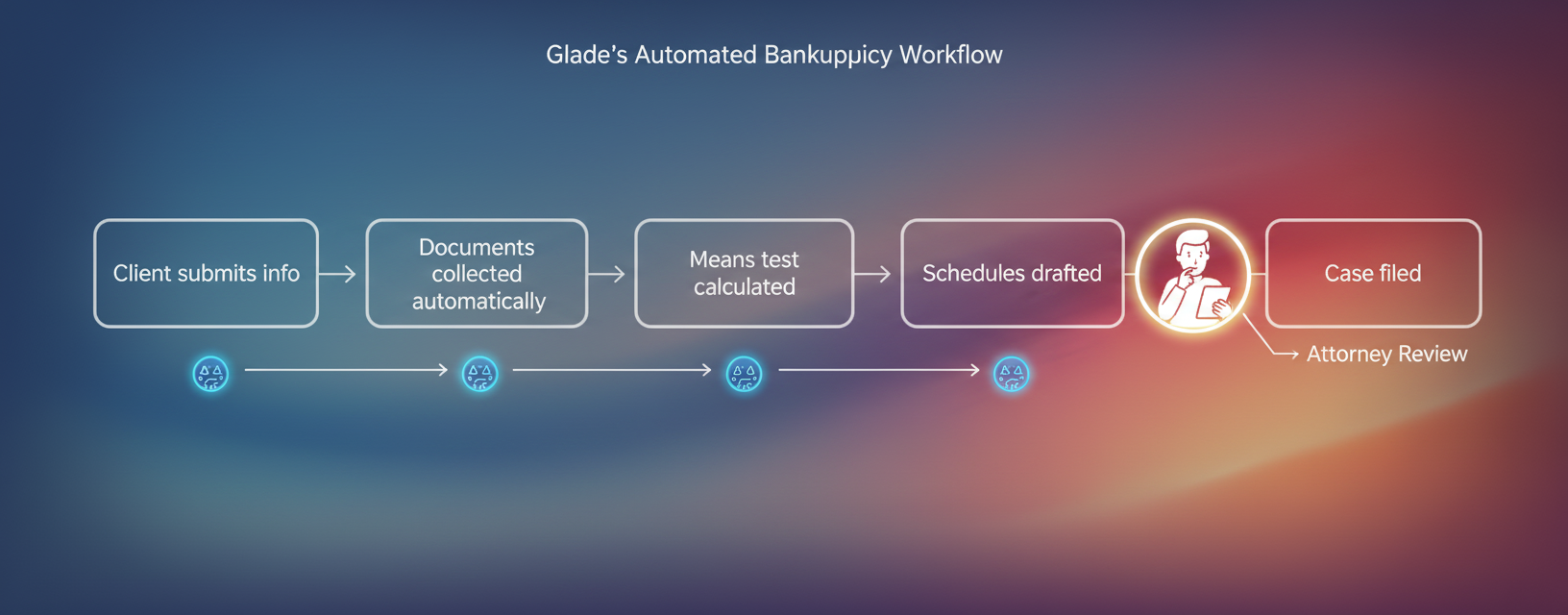
Glade's building blocks let firms customize their workflows to match how they actually work, not how a generic tool assumes they work. This matters in bankruptcy, where case volume is high, margins are tight, and small inefficiencies compound fast.
The result is that attorneys using Glade handle more cases per week without expanding their teams, spending less time on administrative work and more time on the legal judgment that actually requires their expertise.
Bankruptcy Specialization vs. General Practice Management
Clio is built for general law firm management, which means bankruptcy attorneys often find themselves adapting workflows that were never designed with their practice in mind. The software handles calendaring, billing, and document management well across many case types, but it lacks the depth that Chapter 7 and Chapter 13 filings actually require.
Glade takes a different approach. Its case workflows are built for bankruptcy, covering means test calculations, creditor matrix management, and court filing preparation as native parts of the system instead of workarounds.
What Bankruptcy Firms Actually Need
Bankruptcy practice has requirements that general case management tools routinely miss:
- Means test calculations involve precise income and expense comparisons that must meet court standards, beyond simple form-filling.
- Creditor matrix generation requires pulling structured data accurately, since errors can delay or derail a filing.
- Court-specific deadlines and local rules vary by district and need to be tracked consistently across every case.
Clio can support some of these needs through integrations, but that means assembling and maintaining third-party connections. Glade handles these as built-in case workflow building blocks, so nothing falls through the gaps between tools.
Feature | Glade AI | Clio |
|---|---|---|
Bankruptcy Specialization | Purpose-built for Chapter 7 and Chapter 13 cases with native means test calculations, creditor matrix generation, and court-specific deadline tracking built into case workflows | General practice management tool requiring third-party integrations to handle bankruptcy-specific tasks like means testing and creditor matrices |
AI Workflow Automation | AI agents automate document collection, means test preparation, form drafting, and client communication as native parts of the bankruptcy case workflow | Time tracking, billing, and general matter management with AI features not purpose-built for bankruptcy automation |
Document Collection | Automated intake and document collection agents that extract relevant figures from paystubs, tax returns, and bank statements with automatic reminders to clients | Document storage and client portal for manual document sharing, requiring manual data entry for bankruptcy forms |
Court Filing Preparation | Built-in preparation for Schedule A/B, Schedule C, and other bankruptcy forms with data automatically pulled from case workflows | E-filing limited to Texas and Georgia as of 2025, with general document templates that require configuration for bankruptcy use |
Pricing Structure | Purpose-built bankruptcy workflows reduce setup time and eliminate need for third-party integration costs | Starts at $49/user/month for Starter tier, scaling to $109/user/month for Grow tier, with costs compounding across multi-user teams |
Implementation | Bankruptcy-scoped onboarding shortens time between signup and running actual cases through the system | Broad onboarding resources for general law practice requiring bankruptcy-specific configuration by your team |
AI Capabilities and Workflow Automation
Glade was built for bankruptcy attorneys, and that focus shows in how its AI agents work. Instead of offering generic legal automation bolted onto a broader case management system, Glade's workflows are designed around the actual steps of a bankruptcy case.

At the core are AI agents that automate bankruptcy workflows. These agents work across the full case lifecycle, pulling in client data, running calculations, and flagging issues before they reach the attorney's desk.
Here's what Glade's AI agents handle in a bankruptcy workflow:
- Document collection and review, including paystubs, tax returns, and bank statements, with automatic extraction of relevant figures
- Means test calculations built directly into the workflow, reducing manual data entry
- Draft preparation for Schedule A/B, Schedule C, and other core bankruptcy forms
- Client-facing status updates that go out automatically at key case milestones
Clio, by contrast, offers time tracking, billing, and general matter management. Its AI features are not purpose-built for bankruptcy and do not replicate this kind of case-specific automation.
Client Portal and Client Experience
Clio offers a client portal called Clio for Clients, which lets firms share documents, send messages, and collect payments through a dedicated client-facing interface. It covers the basics well, and for general practice firms, it holds up fine.
Glade takes a different approach. Instead of a static portal, Glade builds the client experience directly into its case workflows. Clients interact through automated intake and document collection processes that are all tied to what's actually happening in their case. There's no separate portal to log into because the touchpoints come to the client.
For bankruptcy practices, this matters. Clients in financial distress often struggle with document gathering and follow-through. Having automated reminders and structured collection steps baked into the case workflow means fewer dropped threads and less time spent chasing clients for information your firm needs to move forward.
Pricing and Implementation
Clio's pricing starts at $49 per user per month for its entry-level Starter tier, scaling up to $109 per user per month for the Grow tier that most bankruptcy firms actually need. Costs compound quickly in firms with multiple staff members, and key features like document automation sit behind higher tiers.
Glade's case workflows are purpose-built for bankruptcy, which means the setup process is shorter and the learning curve is narrower. There is no need to configure a generic system to approximate what bankruptcy firms need.
Migration and Onboarding
Switching any case management system takes real effort, and both tools require a transition period.
- Clio's onboarding resources are broad and well-documented, but they are built for general law practice, so bankruptcy-specific configuration still falls on your team.
- Glade's onboarding is scoped to bankruptcy workflows, which reduces the time between signing up and running actual cases through the system.
Why Glade is the Better Choice for Bankruptcy Firms
Clio does what it sets out to do. For firms managing multiple practice areas with straightforward workflows, it holds up. But a general feature set means bankruptcy firms end up patching together workarounds for tasks that should be automated by default.
Glade was built for bankruptcy law. The case workflows are designed around the actual structure of a bankruptcy case, not adapted from a generic legal template. That distinction matters when your team is filing Chapter 7 and Chapter 13 cases week after week.
Where Clio requires manual data entry and third-party integrations to get basic bankruptcy tasks done, Glade's AI agents handle those tasks directly within the case workflow. Document collection, means test prep, creditor matrix assembly: these are built-in building blocks, not add-ons.
For a bankruptcy firm looking to take on more cases without adding headcount, Glade is worth a serious look.
Final Thoughts on Practice Management for Bankruptcy Firms
If you're comparing Clio vs Glade for bankruptcy, the real question is whether you want to configure a general system or start with workflows designed for Chapter 7 and Chapter 13 cases. Glade's AI agents automate the document collection, means testing, and form prep that eat up your team's time every week. More cases, less admin, same headcount. Book a demo and see how bankruptcy workflows work when they're built for your practice from the start.
FAQ
How should I decide between Glade and Clio for my bankruptcy practice?
If your firm handles high volumes of Chapter 7 and Chapter 13 cases and needs bankruptcy-specific features like automated means testing, creditor matrix generation, and court-ready form preparation, Glade is the better fit. Clio works well for general practice firms managing multiple areas, but bankruptcy firms typically end up patching together third-party integrations to handle tasks that Glade builds in by default.
What is the main workflow difference between Glade and Clio for bankruptcy cases?
Glade's case workflows are built around the actual structure of bankruptcy filings, with AI agents that handle document collection, means test calculations, and court form preparation as native building blocks within each case. Clio provides general matter management and requires manual data entry or third-party tools to accomplish the same bankruptcy-specific tasks.
Which system is best for small bankruptcy firms trying to scale without hiring?
Glade is designed for bankruptcy firms that want to increase case volume without expanding headcount, since its AI agents automate the repetitive work that typically requires additional paralegals. Clio serves firms across many practice areas but lacks the depth of bankruptcy automation that directly reduces administrative workload in high-volume Chapter 7 and Chapter 13 practices.
What should I consider when migrating from Clio to a bankruptcy-specific system?
Both systems require a transition period, but the key difference is configuration scope. Clio's onboarding is built for general law practice, meaning you'll still need to configure bankruptcy-specific workflows yourself. Glade's onboarding is scoped to bankruptcy case workflows from the start, which shortens the time between signing up and running actual cases through the system.